
For a long time, "hiring in LATAM" meant one thing: developers. A few extra engineers to help a backlog move faster.
That's not what we're seeing anymore.
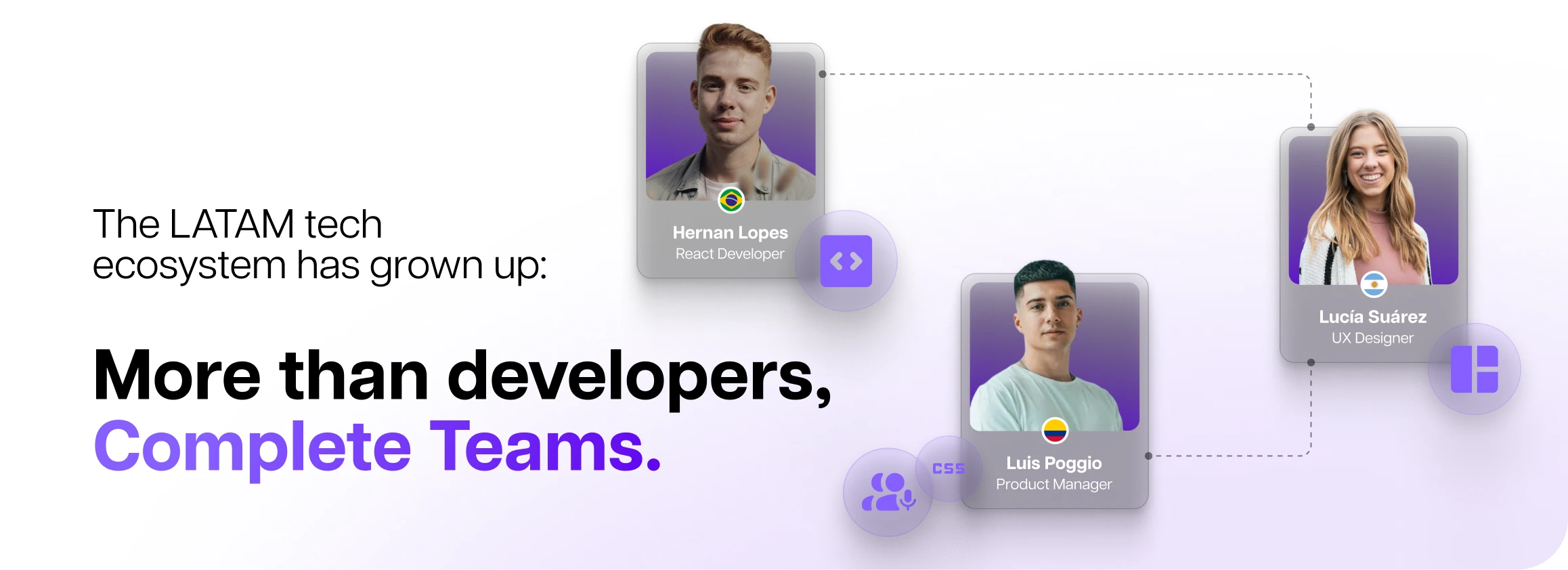
Today, the conversations we have with U.S. companies are about product managers, UX/UI designers, QA engineers, data analysts, AI/ML specialists, DevOps, even technical leadership. Not as an extension of the team. As the team.
That shift is the result of a market that's matured fast, and it's worth understanding why.
The talent ecosystem grew up
A decade ago, LATAM's tech reputation centered on code: write it well, write it fast. Since then, an entire ecosystem has formed around that foundation.
Cities like São Paulo, Buenos Aires, Bogotá, and Mexico City are now home to regional and international offices for companies like Google, Microsoft, Meta, and Amazon, alongside a thriving network of fintechs, startups, and product-driven companies. A whole generation of professionals has come up working inside real product organizations, shaping roadmaps, building design systems, and solving production-level problems.
The result is a talent pool with depth: product managers who've shipped at scale, designers fluent in design systems, QA engineers who think in terms of testing strategy, and data and AI specialists who've worked side by side with ML teams tackling real-world challenges.
The ecosystem matured, and the talent matured with it.
Why companies are building whole teams here, not just hiring developers
The roles around engineering are just as strong
Engineering doesn't ship products on its own. Product, design, QA, and data are part of the same loop, and LATAM's talent pool reflects that. When a company builds a cross-functional team here, instead of splitting "the engineers" from "the rest of the team," everyone is working the same hours, in the same rhythm, with the same context.
Real-time collaboration changes how teams actually work together
When your product manager, designer, and engineers are all online during your working hours, decisions move differently. A design question gets answered in a Slack thread, not a 14-hour wait. A product spec gets clarified live, not interpreted overnight. Standups are actual conversations, not status reports.
Companies are rethinking what "team" means
The remote-first shift didn't just change where people work, it changed how companies think about who's "core" and who's "extended." More and more, the answer is: there isn't a difference. A product manager in Bogotá, a designer in Buenos Aires, and engineers in São Paulo can be just as embedded in a company's roadmap, culture, and decision-making as anyone on a U.S. payroll.
The pool is deep enough to build seniority, not just headcount
Leadership matters as much as execution when you're building a real team. As LATAM's tech scene has grown, so has its bench of senior talent: tech leads, senior designers, staff engineers, and AI specialists who've already led projects of their own. Companies coming here gain judgment as well as capacity.
What this means in practice
If you're thinking about your next hire, or your next five, the real question isn't "should this role be filled by a developer in LATAM?" It's bigger than that: which parts of your team would benefit from working alongside people who understand the full product lifecycle, who are online during your hours, and who are already part of an ecosystem built the way yours is?
For a lot of companies, the answer turns out to be: more roles than they expected.
Final thoughts
The story of LATAM tech talent is about a region that has built the full infrastructure around product development: people, education, companies, culture, all of it working together to produce teams that know how modern software companies actually run.
We've spent years inside this ecosystem. What we know best is how to bring the right people together so they function as one true team.
If you're thinking about what your next team could look like, across engineering, product, design, or AI, that's exactly the kind of conversation we'd love to have.
.webp)
.avif)